








In high‑end electrochemical and fluid systems, filtration is no longer just about “blocking particles.” It is about protecting sensitive components, maintaining stable flow, and ensuring long‑term performance without constant replacement or maintenance.
At the University of California, a leading research team faced exactly this challenge: how to achieve precision filtration that could reliably intercept fine particles—without damaging delicate electrodes or clogging micro‑channels in their experimental setups.
Their solution came from materials engineering: Oqitop’s stainless steel foam discs, featuring controlled pore sizes of 5–50 μm, high structural integrity, and regenerable performance through backwashing.
The Challenge: Clean Fluids, Protected Electrodes, Stable Flow
In advanced research and testing platforms, especially those involving electrochemical cells, flow reactors, or precision analytical instruments, the fluid pathway must meet several strict requirements at the same time:
- Fine particle interception: Remove solid particles, impurities, and carbon powder before they reach critical components.
- Protection of sensitive surfaces: Prevent hard particles from scratching or eroding electrodes and other precision parts.
- Unobstructed flow channels: Avoid partial or complete blockage of narrow flow paths that can cause pressure spikes, measurement errors, or non‑uniform reaction conditions.
- Clean, stable operation over time: Filtration media must not shed fibers or fragments that become a new source of contamination.
- Serviceable and sustainable: Filters that can be backwashed and regenerated are preferred over disposable elements from both cost and environmental perspectives.
Traditional filter media—such as polymer membranes, nonwoven fiber filters, or loose‑packed beds—often show limitations in such demanding applications: they may shed fibers, deform under pressure, clog quickly, or be difficult to clean and reuse.
The University of California team needed a robust, metal‑based, precisely porous filtration medium that could be integrated into disc‑type filter modules—compact, easy to mount, and engineered for repeatable, high‑accuracy experiments.
Oqitop Stainless Steel Foam Discs: Precision Pores, Durable Structure
Oqitop New Material Co., Ltd. has been focusing on advanced porous metal materials, and our stainless steel foam discs were specifically selected to address these challenges.
Controlled Pore Size: 5–50 μm for Precision Filtration
Through carefully controlled foaming and sintering processes, our stainless steel foam achieves a tunable pore size range of 5–50 μm. This allows the University of California team to:
- Efficiently intercept solid particles, fine impurities, and suspended carbon powder
- Filter out microparticles that could otherwise scratch electrodes or accumulate in narrow flow channels
- Maintain a balance between filtration accuracy and acceptable pressure drop
By choosing the appropriate pore size within the 5–50 μm range, the researchers can customize the disc filters to different fluids, particle distributions, and system requirements—whether in electrolyte circulation, carbon‑based slurry systems, or fine chemical streams.
Reliable Particle Capture: Solid Particles, Impurities, Carbon Powder
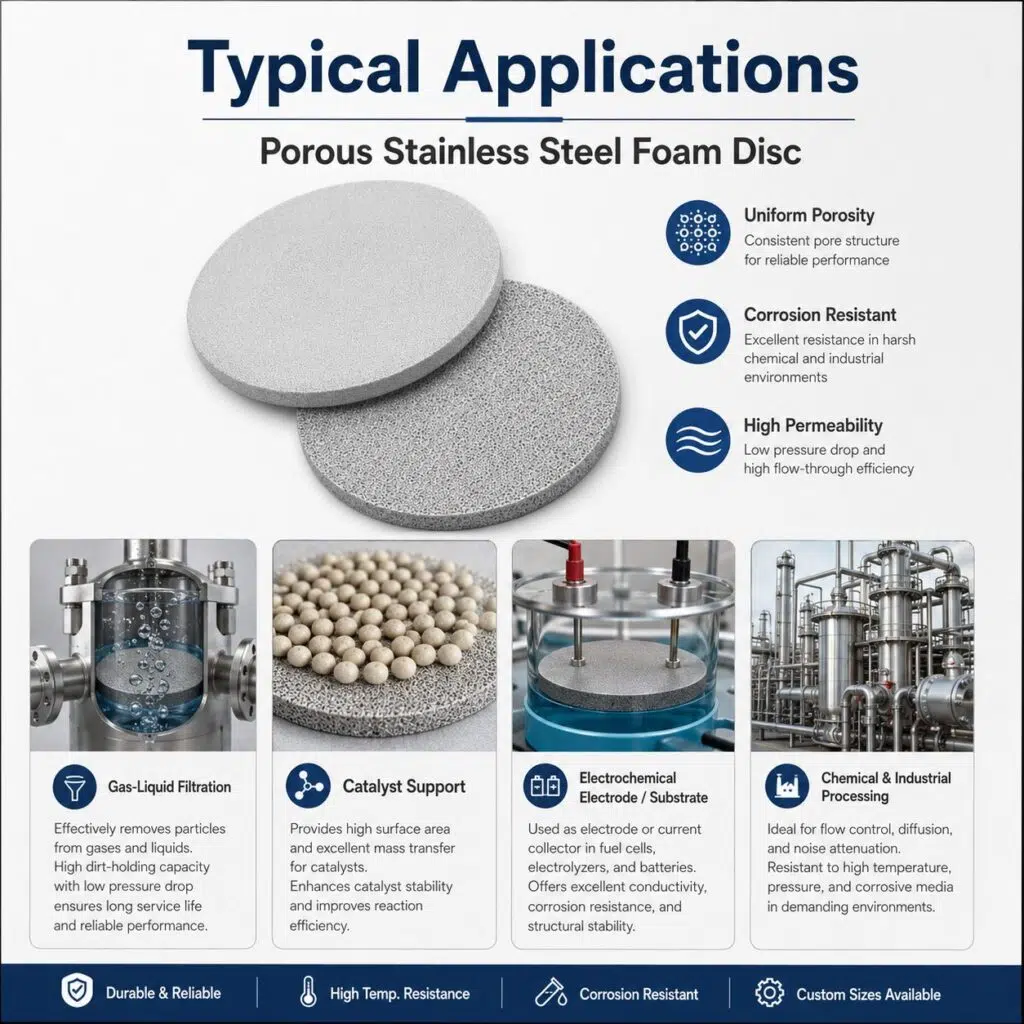
In practice, the stainless steel foam discs at UC are used to:
- Capture solid debris and foreign particles introduced during sample preparation or system assembly
- Filter residual carbon powder and other fine particulates from slurry‑based or carbon‑containing systems
- Minimize contamination of downstream electrodes, sensors, and micro‑channels
The open yet precisely structured foam forms a 3D labyrinth, forcing particles to be intercepted and trapped within the pores while allowing the fluid to pass through more freely.
Protecting Electrodes and Flow Channels
For the University of California researchers, the filtration solution had to do more than just “clean” the fluid; it needed to protect critical components.
Preventing Electrode Scratching
In electrochemical cells or advanced test platforms, the electrode surface often plays a decisive role in experimental accuracy and long‑term stability. Hard particles carried by the fluid can:
- Scratch electrode surfaces
- Remove or damage catalyst layers
- Cause local defects that change reaction behavior
By intercepting particles in the 5–50 μm range, Oqitop stainless steel foam discs act as a protective barrier upstream of the electrodes, reducing mechanical damage risk and extending the effective lifetime of expensive or carefully prepared electrode materials.
Avoiding Channel Blockage
Many modern systems rely on narrow flow channels, micro‑channels, or fine distribution manifolds to ensure uniform flow and precise control of reaction conditions. Particle accumulation in these channels can lead to:
- Partial or complete blockage
- Non‑uniform flow distribution
- Local overheating or concentration gradients
- Instability in experimental data
By placing our stainless steel foam discs at key nodes in the fluid loop, the UC team effectively filters out particles before they can enter these critical pathways, helping maintain stable pressure, uniform flow, and repeatable experimental conditions over longer runs.
Clean and Stable: No Fiber Shedding, Easy to Regenerate
One major advantage of Oqitop’s stainless steel foam, especially when compared to conventional fiber‑based filters, is its solid metallic structure.
No Fiber Shedding
Because the foam is a monolithic sintered metal network, there are:
- No loose fibers to break off and contaminate the fluid
- No risk of polymer or organic debris degrading under heat or chemicals
- No new source of particles introduced by the filter itself
For high‑precision experiments and sensitive analytical systems, this is crucial. The filtration medium must reduce contamination, not add to it.
Backwashable and Regenerable
Instead of replacing filter elements frequently, the University of California team can clean and regenerate the stainless steel foam discs through backwashing or flushing procedures:
- Reverse flow to dislodge trapped particles
- Combine with ultrasonic cleaning or chemical rinsing when necessary
- Restore filtration efficiency without compromising the structure
Stainless steel’s mechanical strength and chemical resistance allow multiple regeneration cycles, significantly extending the service life of each disc and reducing both operating cost and waste.
From Laboratory Evaluation to Reliable Daily Use
In collaboration with Oqitop, the University of California team:
- Selected disc geometries compatible with their existing filter housings
- Chose pore size ranges within 5–50 μm tailored to specific applications
- Evaluated pressure drop, particle capture efficiency, and long‑term structural stability
Over time, the stainless steel foam disc filters have moved from trial components to standard elements in several of their fluid management systems, helping ensure:
- Cleaner electrolytes and process fluids
- Better protection of electrodes, sensors, and micro‑channels
- More consistent, reproducible experimental results
Oqitop: Your Partner in Advanced Metal Foam Filtration
The case with the University of California demonstrates how precision‑engineered stainless steel foam discs can solve real‑world filtration challenges in demanding research and industrial environments.
Oqitop New Material Co., Ltd. offers:
- Customized pore sizes (5–50 μm and beyond) for different particle size distributions
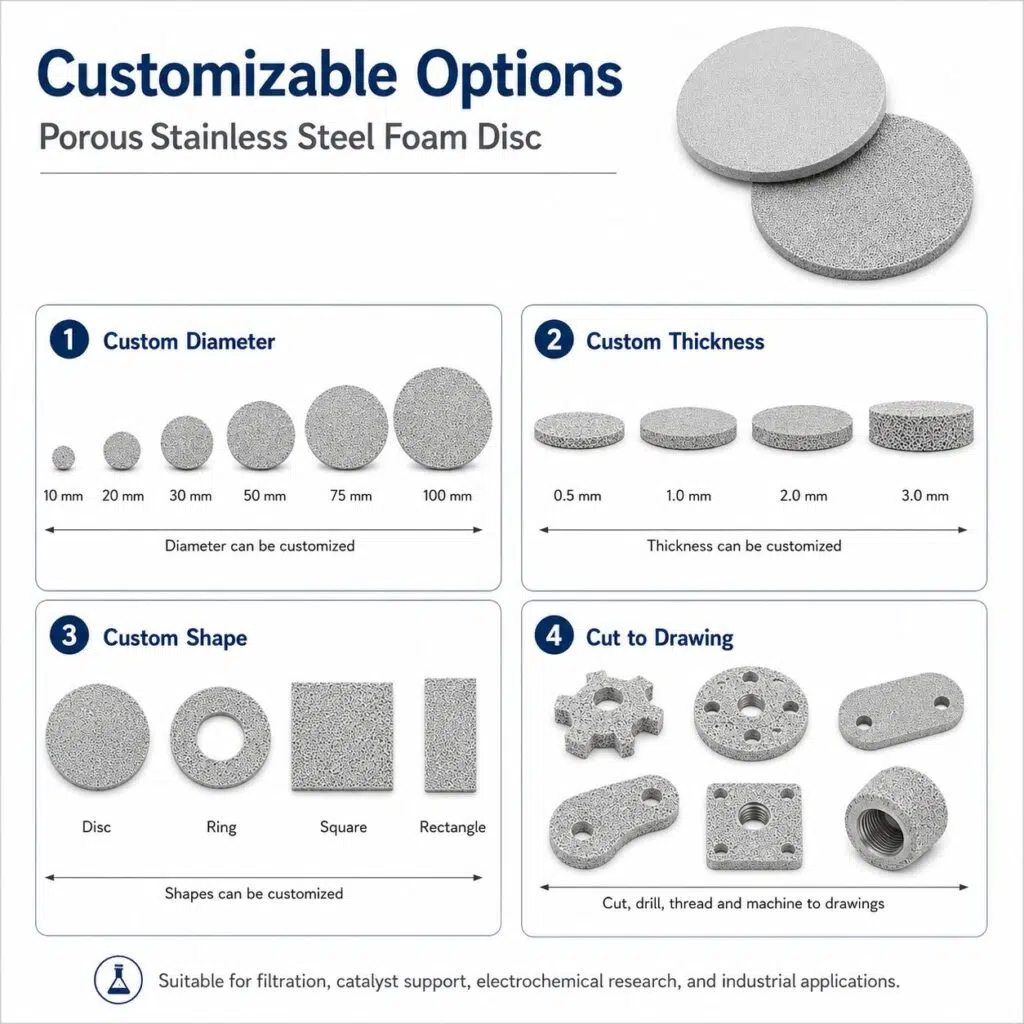
- Various disc diameters, thicknesses, and densities to fit your hardware
- Technical support on filter design, integration, and regeneration strategies
If your system requires fine, reliable particle interception, protection of sensitive components, and a durable, backwashable filter with no fiber shedding, Oqitop’s stainless steel foam discs may be the key component you are looking for.
—
Oqitop New Material Co., Ltd.
Advanced porous metal solutions for precision filtration and next‑generation fluid systems.