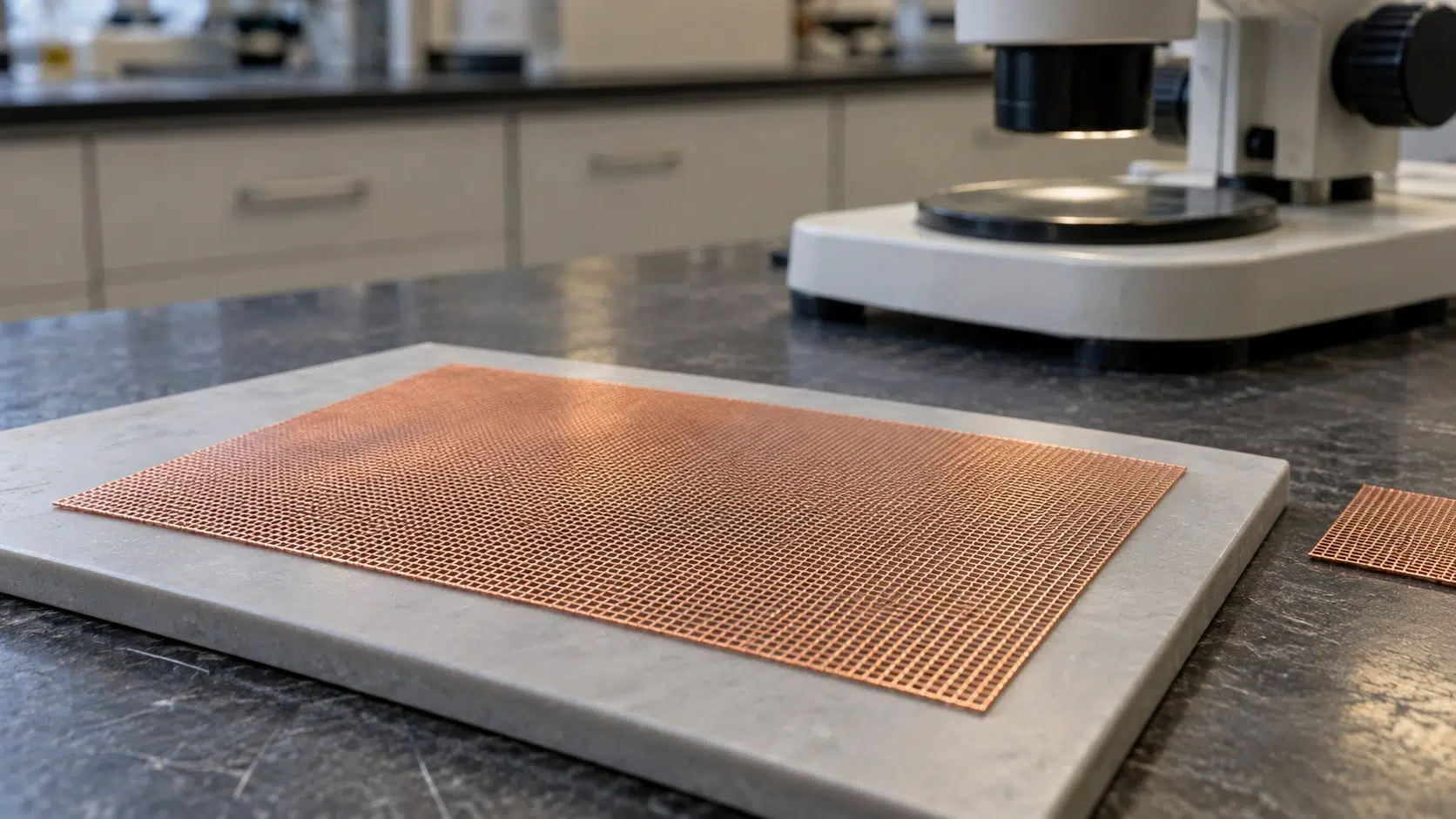








KunShan Oqitop New Material Co., Ltd. (OQITOP) has produced precision copper mesh for Korea University in South Korea, supporting laboratory filtration research with a material designed around demanding experimental requirements.
In laboratory filtration, the mesh is an important part of the experimental setup. Its opening size, aperture consistency and physical condition can influence the separation process. For researchers working with carefully defined samples, selecting an appropriate mesh helps establish a clearer basis for testing and comparison.
The copper mesh developed for this project is intended for precision filtration applications. The emphasis is on matching the mesh specification to the laboratory’s requirements, so that the material can be evaluated within the intended apparatus and operating conditions.
A useful precision specification covers several connected parameters: aperture size and its allowable variation, mesh thickness, open area and finished sample dimensions. Each serves a practical purpose. The openings define the geometry of the screening surface, while thickness and open area are relevant to handling, support and flow through the mesh. Considering these parameters together helps researchers select a material suited to their experiment.
For filtration studies, dimensional precision and filtration performance are related but distinct. Aperture measurements describe the mesh itself; particle-retention results describe its behavior under particular test conditions. Flow rate, pressure difference, the test medium and particle characteristics should therefore be recorded when evaluating performance. Reporting both mesh dimensions and test conditions gives researchers a clearer basis for evaluating and reproducing filtration results.
The fit between the mesh and its holder also deserves attention. Secure mounting and an appropriate edge seal help direct flow through the intended filtration area. Material compatibility with the test medium, specimen handling and cleaning requirements are further considerations when planning a laboratory evaluation.
The Korea University project reflects OQITOP’s focus on supplying metal materials for research applications. A clearly defined sample specification helps connect the research team’s objectives with the material that enters the laboratory.
OQITOP welcomes inquiries from universities, research institutes and industrial R&D teams seeking precision copper mesh. Share your required aperture size, tolerance, mesh thickness, sample dimensions, quantity and intended filtration conditions. Our team can review your requirements and discuss available material and sample options.
Contact OQITOP: james@oqitop.com